The California Consumer Privacy Act (CCPA) is a landmark piece of legislation that was enacted to enhance privacy rights and consumer protection for residents of California, United States. The CCPA was signed into law on June 28, 2018, and came into effect on January 1, 2020. This law was a significant step towards giving consumers more control over the personal information that businesses collect about them. Here are key details of the CCPA:

Purpose and Scope

  • Consumer Rights: The CCPA aims to provide California residents with the right to know about the personal data collected about them, the right to delete personal data held by businesses, the right to opt-out of the sale of personal data, and the right to non-discrimination for exercising their CCPA rights.

  • Applicability: The CCPA applies to any for-profit entity that does business in California and meets any of the following criteria: has annual gross revenues in excess of $25 million; buys, receives, sells, or shares the personal information of 50,000 or more consumers, households, or devices; or derives 50% or more of its annual revenues from selling consumers' personal information.

Key Provisions

  • Transparency: Businesses must disclose the categories of personal information they collect, the purposes for which the personal information is used, and any third parties with whom the information is shared.

  • Right to Access: Consumers have the right to request a copy of the specific personal information collected about them over the past 12 months.

  • Right to Deletion: Consumers have the right to request the deletion of their personal data held by businesses and by extension, their service providers.

  • Right to Opt-Out: Consumers have the right to opt-out of the sale of their personal information. For minors under the age of 16, affirmative consent is required to sell their personal information.

  • Non-Discrimination: Businesses cannot discriminate against consumers who exercise their CCPA rights.

Enforcement and Penalties

  • Enforcement: The California Attorney General is responsible for enforcing the CCPA. However, there is a provision for a private right of action for unauthorized access and exfiltration, theft, or disclosure of a consumer's nonencrypted and nonredacted personal information as a result of a business's violation of the duty to implement and maintain reasonable security procedures.

  • Penalties: For violations of the CCPA, businesses can be fined up to $7,500 per intentional violation and $2,500 per unintentional violation if the violation is not cured within 30 days of notification. Consumers can also seek damages between $100 and $750 per consumer per incident, or actual damages, whichever is greater, in cases of data breaches.

Amendments and Future Developments

Since its inception, the CCPA has been subject to amendments to address ambiguities and operational challenges. Additionally, the California Privacy Rights Act (CPRA), also known as Proposition 24, was passed in November 2020, amending and expanding the CCPA, which introduces additional rights and protections for consumers and obligations for businesses. The CPRA's provisions are scheduled to come into effect on January 1, 2023, with some provisions having a look-back period.

The CCPA represents a significant shift towards more robust data privacy practices in the United States, similar in spirit to the European Union's General Data Protection Regulation (GDPR). It underscores California's role as a leader in the push for consumer privacy.

Know of another uptime or system status page we can list? If so, send it to This email address is being protected from spambots. You need JavaScript enabled to view it..

The Common Education Data Standards (CEDS) is a collaborative effort to develop a common vocabulary for educational data across the United States. CEDS is designed to help education agencies and institutions manage, analyze, and exchange educational data efficiently. Here are some key aspects of CEDS:

Goals and Purpose

  • Standardization: CEDS aims to standardize data definitions and formats, making it easier to compare and share data across different educational institutions and agencies.
  • Interoperability: The standards support data interoperability, allowing systems to communicate more effectively and share information seamlessly.
  • Improved Data Quality: By providing clear definitions and guidelines, CEDS helps ensure that educational data is accurate, consistent, and reliable.

Key Components

  • Elements: CEDS includes a comprehensive set of data elements, which are individual pieces of information (e.g., student demographics, course enrollment, assessment results).
  • Entities: These are broader categories that group related data elements (e.g., students, staff, courses, assessments).
  • Connections: CEDS defines relationships between data elements and entities, illustrating how data points are linked (e.g., a student is enrolled in a course, a course has an assessment).
  • Descriptors: These provide detailed descriptions and options for specific data elements (e.g., race/ethnicity categories, grade levels).

Development and Maintenance

  • Collaborative Process: CEDS is developed and maintained through collaboration among federal, state, and local education agencies, as well as institutions of higher education and other stakeholders.
  • Feedback and Updates: The standards are periodically updated based on feedback from the education community and changes in policy and practice.

Usage and Implementation

  • Voluntary Adoption: While adoption of CEDS is voluntary, many education agencies and institutions choose to implement the standards to improve data management and reporting.
  • Tools and Resources: CEDS provides various tools and resources to help organizations implement the standards, including the CEDS Align tool for mapping local data to CEDS and the CEDS Connect tool for developing and sharing use cases.

Benefits

  • Enhanced Decision-Making: Standardized data facilitates better decision-making by providing clear, comparable, and high-quality information.
  • Efficiency: Streamlined data exchange processes reduce the time and effort needed to collect, manage, and report educational data.
  • Policy and Research: Consistent data standards support educational research and policy analysis by providing a common framework for data collection and interpretation.

In summary, CEDS is a crucial initiative for improving the quality, consistency, and interoperability of educational data, supporting better outcomes for students and more effective educational practices.

PUC ELPI LEVELS


Historic ELPI levels by School 2020-21 2021-22 2022-23 2023-24 2024-25 2025-2026
 
PUC CALS MS and HS No Data 66.7% 51.4% TBD TBD TBD
 
PUC Community Charter MS and HS No Data 65.4% 73.8% TBD TBD TBD
 
PUC Community Charter Elementary
No Data 63.2% 42.1% TBD TBD TBD
 
PUC eCALS High School No Data N/A N/A TBD TBD TBD
 
PUC Excel Charter Academy No Data 72.2% 53.8% TBD TBD TBD
 
PUC Inspire Charter Academy No Data 59.0% 62.1% TBD TBD TBD
 
PUC Lakeview Charter Academy (LCA) No Data 62.2% 65.9% TBD TBD TBD
 
PUC Lakeview Charter High School No Data 53.1% N/A TBD TBD TBD
 
PUC Milagro Charter School No Data 70.0% 61.5% TBD TBD TBD
 
PUC Nueva Esperanza Charter Academy No Data 60.3% 48.5% TBD TBD TBD
 
PUC Triumph Charter MS and High School
No Data 70.1% 71.9% TBD TBD TBD
 
AVERAGE   64.2% 59.0%      
 
English Learner Progress Indicator            
 
65% OR GREATER Very High          
 
55%-65% High          
 
45%-55% Middle          
 
35-45% Low          
 
35% OR LOWER Very Low          
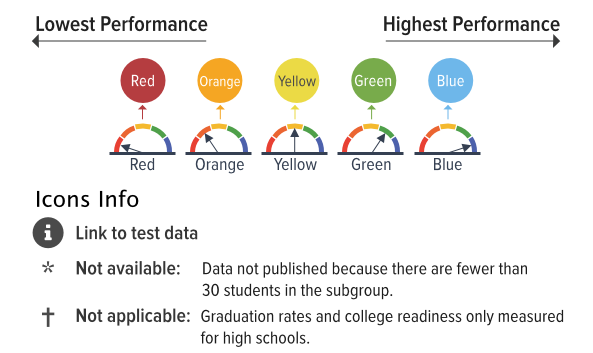
School NameCareer and College Readiness IndicatorChronic Absenteeism RateSuspension RatesEnglish Lang. Arts PerformanceHigh Math PerformanceHigh School Graduation RateEnglish Learner Progress Indicator
 20222023202220232022202320222023202220232022202320222023
PUC CALS Middle School and Early College High N/A 3 1 1 5 4 2 4 2 3 4 2 5 2
PUC Community Charter Elementary NA NA 1 1 5 5 2 4 2 3 NA NA 4 1
PUC Community Charter Middle and PUC Community Charter Early College High NA 5 2 2 5 5 3 3 2 2 5 5 5 5
PUC Early College Academy for Leaders and Scholars NA 4 NA NA 4 5 3 2 2 2 3 4 * *
PUC Excel Charter Academy NA NA 1 3 5 5 2 3 1 2 NA NA 5 2
PUC Inspire Charter Academy NA NA 1 1 5 4 1 3 1 2 NA NA 4 3
PUC Lakeview Charter Academy
2024 California Distinguished School
NA NA 1 3 5 3 2 3 2 3 NA NA 4 5
PUC Lakeview Charter High School * 4 * * 4 4 4 4 2 2 5 5 3 *
PUC Milagro Charter NA NA 1 1 5 5 4 4 4 5 NA NA 5 3
PUC Nueva Esperanza Charter Academy NA NA 1 1 5 3 2 2 2 1 NA NA 4 2
PUC Triumph Charter Academy and Triumph Charter High
2024 California Distinguished School
* 4 1 2 5 4 2 5 2 3 5 5 5 5


notes